Service Period: 2 on-site sessions at BAI, each 2.5 hours, on June 03 – 04, 2026, each day from 10 – 12.30 pm (Berlin time)
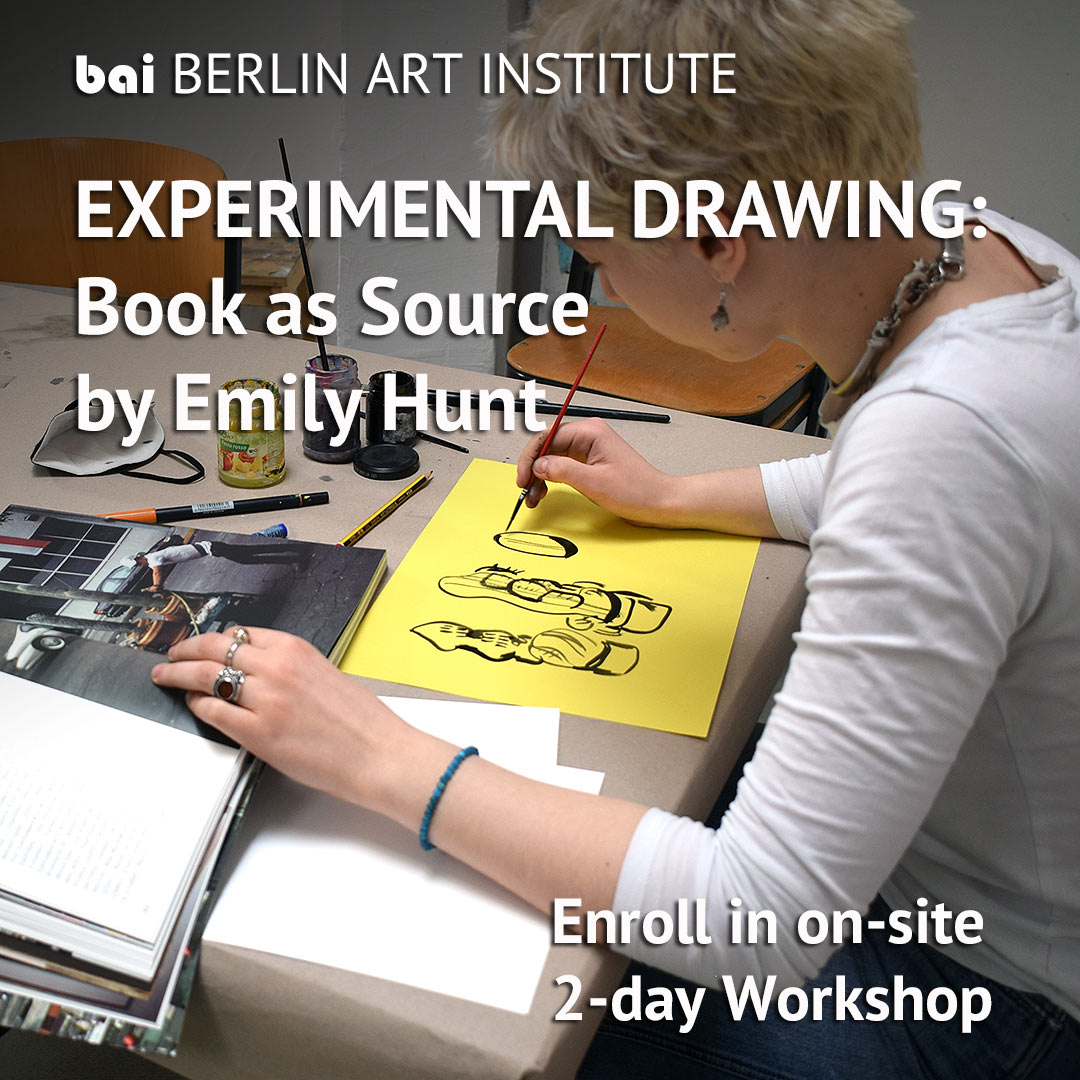
Workshop EXPERIMENTAL DRAWING: Book as Source: Spontaneous idea collecting by Emily Hunt
€95.00
VAT-exempt pursuant to Paragraph 4 No. (21) (a)(bb) UStG (German Value Added Tax Act)
12 in stock
12 in stock
Description
In this two-part experimental drawing course, we will cover the book as an eternal source material, providing ideas, concepts and free-thinking models for making spontaneous drawings. When one is stuck for ideas, the book is the place to turn. Emily Hunt will discuss how she has used different books to create bodies of work for exhibition. She will also discuss the wonder of bookstores, the cost of their disappearance and the divinatory potential of Bibliomancy.
On the first day, there will be short introduction to the history and contemporary use of artist books in drawing, printmaking and collage. The lecture will begin by covering surrealist artist books and investigate current contemporary artist books, occasionally referred to as ‘zines’. Producing and selling zines is one of the best ways to create an artwork to be seen by a larger audience, without the restrictions of applying to galleries or installing exhibitions.
Using the library as Berlin Art Institute as a location, we will choose a book at random to focus upon for the two-day course, discussing each book and delving into the ideas around them. As we pass the book on, we will share a piece of information. The drawings and discussion will create connections that will lead to how and why the drawings were created.
On the second day, we will begin with a short presentation of unusual places and sources for inspiration in Berlin. The participants will then collaboratively decide the best drawings from the intensive drawing session the day before. We will install the exhibition together, discussing how images speak to each other. The outcomes will be discussed.
This model of connecting ideas and mind-mapping will also be used to create a visual artist statement, as opposed to a written traditional artist statement. This will be thought over as homework and spoken upon in dialogue in a group tutorial setting, at the end of the second day.